Exposure of airport workers to Kerosine engine exhaust (KEE) en Diesel engine exhaust (DEE)
Overview
Type of intervention(s):
Inspection campaignNumber of inspections undertaken:
Subsequent to workers and a trade union filing complaints to the Netherlands Labour Authority about serious exposure to KEE (and DEE) in 2021, inspections started at the national airport Schiphol Amsterdam. Subsequently, in 2025 inspections were started at 4 other major airports. All airports have been visited and inspected many times, and in the meantime intensive talks with the various employers involved were held, focusing on progress made in reducing exposure.
Duration of campaign:
Ongoing since 2021Scope of intervention
Key duties
KEE contains various carcinogenic components, and in July 2026, the Dutch Health Council formally classified KEE as a human carcinogen. DEE is a formally classified carcinogen as well. Therefore, employers have to take action to either prevent exposure to KEE end DEE completely (by substitution), and if not, to minimize exposure as much as possible.
Employers should prepare detailed and ambitious plans of action.
For DEE: Diesel powered equipment should be substituted by electric (or hydrogen) powered equipment where technically feasible. E.g., for power supply to airplanes, direct (electric) power supply from the airport facilities or electric Ground Power Units should be used instead of diesel Ground Power Units. If substitution is not possible yet: minimisation of exposure by using the cleanest diesel engine available, and/or installing soot filters.
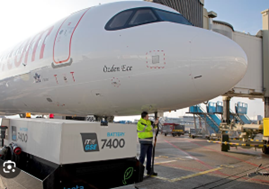
For KEE, among others: reducing the use of the Auxilliary Power Units (‘tail engine’) for power supply to the airplane (by using e-GPU’s), reducing the number of engines used while taxiing, increasing the distance between workers and airplanes, emission-free taxiing by using electric powered tow trucks.
Focus of the Campaign
Enforcing the airports as an employer as well as airlines and various contractors working at airport aprons to take measures to significantly reduce workers’ exposure to KEE en DEE.
Key findings of intervention
Positive findings
After some initial resistance, the airports, airlines and subcontractors at the airports have become quite active in substituting diesel powered equipment and in implementing measures to reduce exposure to KEE as much as possible.
Negative findings
While exposure to DEE can in many cases be effectively reduced by substitution, this is not possible with KEE. It remains challenging to reduce exposure of workers to KEE truly significantly, although serious attempt are being made – as well as some progress.
General findings
It may be challenging to change operations at airports in order to reduce workers’ exposure to KEE, as many other issues have to be taken into account. E.g., safety issues when the routing of airplanes are changed in order to increase the distance between workers and airplanes. Many other authorities have to be involved, and many other regulations are present (in addition to occupational health regulations). On the other hand, environmental regulations have supported the implementation of measures to reduce workers’ exposure.
Key outcomes following intervention
Initial resistance was overcome by showing the need to minimize exposure to the carcinogens present in KEE and DEE. Employers finally took largescale action. However, intensive talks with and consultation of other authorities was needed.
Level and type of enforcement issued
- Improvement notice
- Fines
Key EU legislation
- CMRD
Images
 .
Electric tow truck in use at Schiphol Airport
.
Electric tow truck in use at Schiphol Airport